

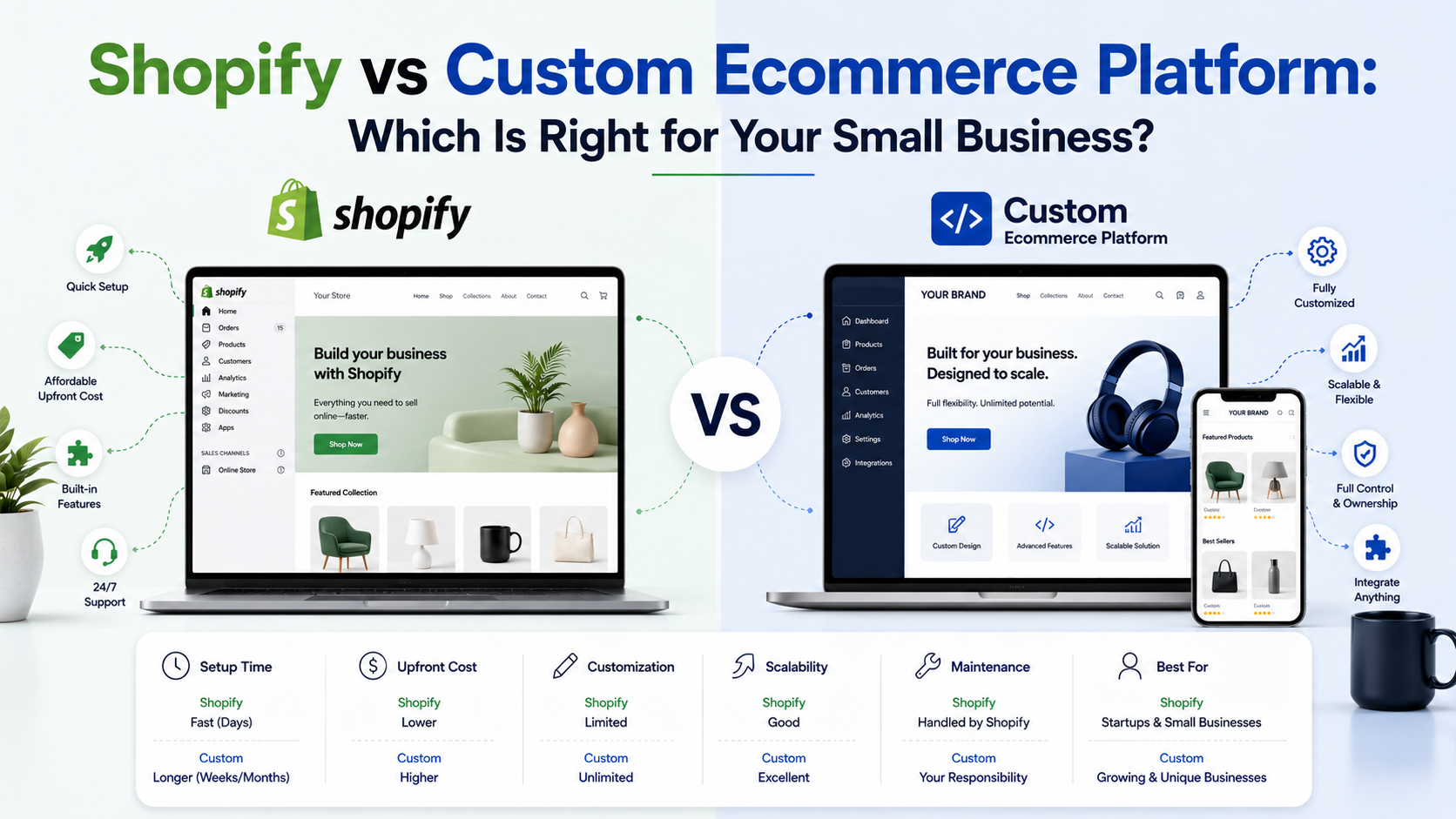
If you’re stuck comparing Shopify vs custom ecommerce platform options, you’re probably tired of vague advice that doesn’t match your actual budget or timeline. Both paths can work — but they solve different problems. The right choice depends less on what’s “better” and more on where your business is right now.
Here’s a straightforward breakdown to help you decide.
What’s the Real Difference Between Shopify and a Custom Platform?
Shopify is a hosted, subscription-based platform. You rent the infrastructure, use pre-built themes and apps, and launch fast with minimal technical setup.
A custom ecommerce platform is built specifically for your business — your workflows, your catalog structure, your integrations. You own the code, but you (or a developer) are responsible for building and maintaining it.
Neither is inherently better. They’re built for different stages of growth.
How Much Does Shopify Actually Cost?
Shopify’s pricing is predictable, which is part of its appeal:
- Basic plan: around $39/month
- Shopify plan: around $105/month
- Advanced plan: around $399/month
- Plus transaction fees if you’re not using Shopify Payments (typically 0.5%–2%)
- App subscriptions for extra features (email marketing, reviews, inventory sync) often add $50–$300+/month depending on your stack
For a small store doing $10,000–$50,000/month in sales, total platform costs often land somewhere between $150–$600/month once apps are factored in.
How Much Does a Custom Ecommerce Platform Cost?
Custom builds have a higher upfront investment but no recurring platform fee. Depending on complexity — product catalog size, payment integrations, custom checkout logic, inventory systems — a custom build can range from $8,000 to $50,000+ as an initial project, plus ongoing hosting and maintenance (often $100–$500/month).
The tradeoff: you’re paying for flexibility and ownership, not convenience.
A Quick Example
A handmade jewelry seller with 40 SKUs and simple shipping needs will likely spend less overall — and launch faster — on Shopify. A wholesale distributor needing custom pricing tiers, a client login portal, and integration with an existing warehouse system will often hit Shopify’s limits and need custom development to avoid working around the platform instead of with it.
When Shopify Makes Sense
Shopify is a strong fit if you:
- Want to launch in weeks, not months
- Sell a straightforward product catalog
- Don’t need deeply custom workflows
- Prefer predictable monthly costs over large upfront spend
- Want access to a large app ecosystem for common features
For most small businesses starting out, this is the lower-risk starting point.
When a Custom Platform Makes Sense
A custom build is worth considering if you:
- Have outgrown what Shopify apps can reasonably handle
- Need tight integration with internal tools, ERPs, or custom logistics
- Require unique checkout, pricing, or subscription logic
- Plan to scale into a highly specific customer experience competitors can’t easily replicate
- Want full ownership of your codebase long-term
This path takes longer and costs more upfront, but it removes the ceiling that off-the-shelf platforms eventually create.
What About Multi-Channel Selling (Amazon, eBay, Etsy)?
If you’re selling across Shopify, Amazon, eBay, and Etsy simultaneously, platform choice affects how easily you can sync inventory and orders. Shopify has established integrations for most marketplaces, which is one reason many small businesses stay on it even as they scale — switching to custom often makes sense only once multi-channel complexity outgrows what those integrations can handle. This is an area where working with a team that regularly builds ecommerce integrations across Shopify, Amazon, eBay, and Etsy can save you from costly trial and error.
A Middle Path: Hybrid Setups
Many small businesses don’t need a fully custom platform to solve their biggest pain points. Sometimes the real issue is inventory syncing, manual order entry, or repetitive tasks eating up hours each week — problems that custom automation can solve without rebuilding your entire storefront.
If that sounds familiar, it’s worth exploring whether targeted automation, rather than a full platform rebuild, actually solves the problem you’re running into.
So, Which Should You Choose?
Ask yourself these three questions:
- Is my current bottleneck a platform limitation, or a process problem? (Often it’s the latter.)
- Can I quantify what a custom build would save or earn me over 2–3 years? If not, Shopify is the safer starting point.
- Do I have the budget for both the build and ongoing maintenance? Custom platforms aren’t “set it and forget it” — they require upkeep like any software product.
There’s no universally correct answer here — only the right answer for your current stage, budget, and growth plans.
If you’re weighing this decision for your own store, it can help to talk it through with a team that builds both Shopify stores and custom platforms, so the recommendation isn’t biased toward one option. You can explore ZM Collab’s ecommerce development services to get a clearer picture of what fits your specific situation.
Image Alt Text Suggestions
- “Side-by-side comparison of Shopify vs custom ecommerce platform dashboards”
- “Small business owner reviewing ecommerce platform costs on a laptop”
- “Custom ecommerce platform product catalog interface for a small business”
Internal Linking Suggestions
- “ecommerce integrations across Shopify, Amazon, eBay, and Etsy” → Ecommerce Services page
- “custom automation” → Automation Services page
- “custom web app development” → Custom Web Apps page
FAQ Section
Is Shopify or a custom platform cheaper for a small business? Shopify is usually cheaper upfront and has predictable monthly costs. Custom platforms cost more initially but avoid recurring app and transaction fees, which can even out over time depending on your sales volume and app usage.
Can I switch from Shopify to a custom platform later? Yes. Many businesses start on Shopify and migrate to a custom platform once they outgrow its app-based limitations. Migration requires planning around product data, order history, and integrations, so it’s worth budgeting time for.
Do I need coding knowledge to run a custom ecommerce platform? No, but you’ll need a developer or agency for ongoing updates and fixes, since custom platforms don’t come with built-in support the way Shopify does. Factor this into your maintenance budget.
How do I know if Shopify’s app limitations are actually holding my business back? Look for repeated manual workarounds — spreadsheets, duplicate data entry, or workflows apps can’t quite handle. If these are frequent and costly in time, it may signal you’ve outgrown Shopify’s off-the-shelf capabilities.