
If you’re spending more time answering emails, updating orders, and managing repetitive tasks than growing your business, you’re not alone. Many small business owners eventually ask the same question: ai automation vs virtual assistant—which is the smarter investment? The answer depends on the type of work you’re trying to eliminate, your budget, and how your business operates.
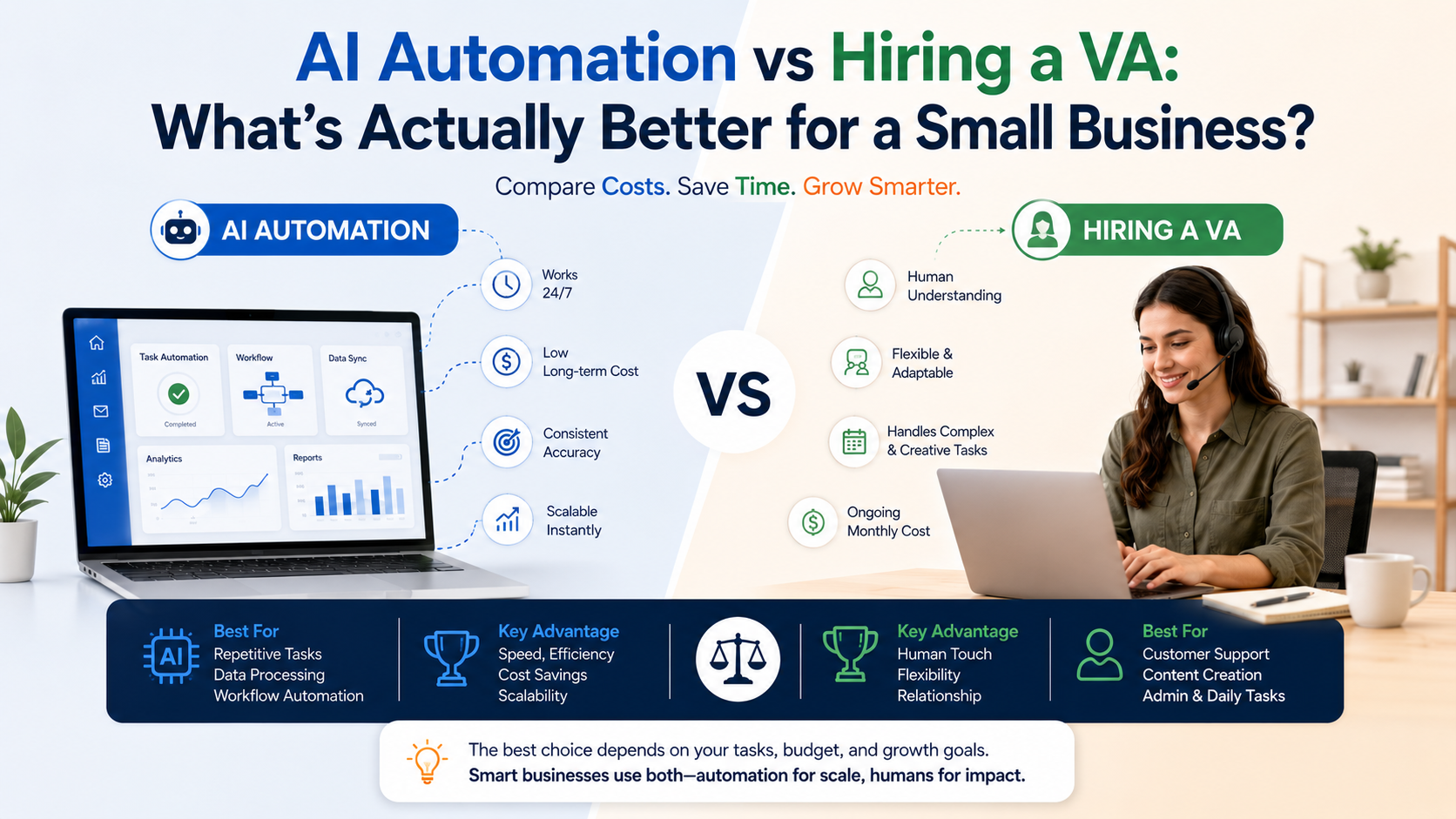
Neither option is a complete replacement for the other. AI automation excels at repetitive, rule-based tasks, while a virtual assistant provides human judgment, communication, and flexibility. Understanding where each fits can help you invest your time and money more effectively.
AI Automation vs Virtual Assistant: What’s the Difference?
When comparing ai automation vs virtual assistant, it’s important to understand that they solve different business challenges.
A virtual assistant (VA) is a person who performs tasks remotely. They can communicate with customers, manage schedules, conduct research, organize files, and assist with projects that require critical thinking or personal interaction.
AI automation uses software to complete predefined workflows automatically. Instead of manually repeating the same tasks every day, automation moves information between your business systems according to rules you establish.
For many ecommerce businesses, this means fewer repetitive tasks while maintaining oversight of important operations.
Automation vs VA: Which Tasks Are Better for Each?
A common mistake is expecting one solution to do everything. The reality is that automation vs VA isn’t about choosing a winner—it’s about matching the right solution to the right task.
Tasks Ideal for AI Automation
AI automation performs well when processes follow clear, repeatable rules.
Examples include:
- Sending order confirmation emails
- Updating inventory across sales channels
- Creating invoices
- Syncing customer information to a CRM
- Routing customer inquiries
- Generating recurring reports
- Updating shipping statuses
These tasks don’t require creativity or judgment, making them excellent candidates for automation.
Tasks Better Suited for a Virtual Assistant
Human support remains valuable for responsibilities involving communication and decision-making.
A VA can help with:
- Customer service conversations
- Appointment scheduling
- Supplier communication
- Product research
- Social media engagement
- Administrative support
- Following up with leads
If the task changes frequently or depends on context, a person is usually the better option.
Comparing Costs: Automation vs VA
Budget is often one of the biggest deciding factors for small business owners.
Here’s a simple comparison:
| Option | Typical Cost Structure | Best For |
| Virtual Assistant | Hourly or monthly | Human communication and flexible support |
| AI Automation | Setup plus software costs | Repetitive workflows and system integration |
For example, hiring a VA for 20 hours per week at $20 per hour costs approximately $1,600 per month before considering onboarding or management time.
By comparison, AI automation usually involves an implementation cost plus any software subscriptions. Once workflows are configured, they can continue handling repetitive tasks without requiring hourly labor, though they still need occasional monitoring and updates.
The right investment depends on where your business spends the most time.
Business Automation Tools Can Reduce Repetitive Work
Today’s business automation tools allow small businesses to connect ecommerce platforms, accounting software, CRMs, shipping providers, and email systems into a single workflow.
Instead of manually copying information between applications, connected systems can automatically:
- Update inventory after each sale
- Notify customers when orders are processed
- Create shipping records
- Send invoices
- Synchronize customer data
These business automation tools don’t replace people. They simply reduce repetitive administrative work, helping teams focus on tasks that require human attention.
For businesses selling on Shopify, Amazon, Etsy, or eBay, connected workflows can significantly simplify day-to-day operations.
When to Hire a VA Instead of Automating
Business owners often ask when to hire a VA rather than investing in automation.
Consider hiring a VA if your business needs:
- Personalized customer communication
- Administrative support
- Calendar management
- Research and data collection
- Creative assistance
- Flexible problem-solving
A virtual assistant can adapt to changing situations in ways software cannot.
If your daily workload changes significantly or requires conversation and judgment, when to hire a VA becomes a much easier decision.
A Practical Example
Imagine a small ecommerce business receiving 40 orders each day.
Without automation, an employee may spend:
- Two minutes updating inventory
- Two minutes sending customer emails
- Three minutes creating invoices
- Three minutes updating internal records
That’s roughly 10 minutes per order, or about 6.5 hours every day spent on repetitive administrative work.
AI automation can connect these systems so many of these routine tasks happen automatically after an order is placed. Staff can then focus on customer support, quality control, and business growth rather than copying information between platforms.
Can You Use Both?
Absolutely.
For many growing businesses, the most practical approach isn’t choosing between automation vs VA—it’s combining both.
For example:
- AI automation manages repetitive workflows.
- A VA handles customer conversations and unique requests.
This balanced approach helps business owners improve efficiency while maintaining the personal service customers expect.
How ZM Collab Supports Growing Businesses
Every business has different workflows, software, and operational needs. Rather than relying on disconnected tools, ZM Collab helps businesses build practical automation solutions that integrate ecommerce platforms, internal systems, and business processes into connected workflows.
For businesses with more advanced requirements, automation can also be combined with custom web applications to support unique operational needs as the business grows.
Final Thoughts
The decision between ai automation vs virtual assistant isn’t about replacing people with technology. It’s about understanding which tasks benefit from automation and which still require human expertise.
If your business spends hours each week on repetitive, rule-based work, automation may offer long-term efficiency. If your biggest challenges involve communication, organization, or customer relationships, hiring a VA may be the better fit. Many businesses ultimately benefit from using both together.
If you’re ready to explore practical workflow improvements, visit ZM Collab’s Automation Services page to learn how connected automation can support your business.
Image Alt Text Suggestions
- AI automation vs virtual assistant comparison for a small ecommerce business
- Business owner evaluating AI automation vs virtual assistant solutions
- Dashboard showing business automation tools connected to an online store
Internal Linking Suggestions
- AI automation services for small businesses → Automation Services
- Ecommerce development for Shopify, Amazon, Etsy, and eBay → Ecommerce Services
- Custom web applications for business workflows → Custom Web Apps
- Mobile apps for business management → Mobile App Development
FAQ
Is AI automation better than hiring a virtual assistant?
It depends on the type of work your business needs help with. AI automation is ideal for repetitive, rule-based tasks, while a virtual assistant is better suited for customer communication, scheduling, research, and responsibilities requiring judgment or flexibility.
When should I hire a VA instead of using automation?
If your workload includes customer support, appointment scheduling, research, or tasks that change frequently, hiring a virtual assistant is often the better choice. Automation works best when processes are predictable and follow consistent business rules.
What business automation tools are useful for ecommerce stores?
Common business automation tools connect ecommerce platforms with inventory systems, CRM software, accounting applications, shipping providers, and email platforms. They help reduce manual data entry and improve consistency across daily business operations.
Can small businesses use both AI automation and a virtual assistant?
Yes. Many small businesses use automation for repetitive workflows while relying on a virtual assistant for customer interactions, administrative support, and tasks requiring human judgment. Combining both approaches can improve efficiency without sacrificing personalized service.