

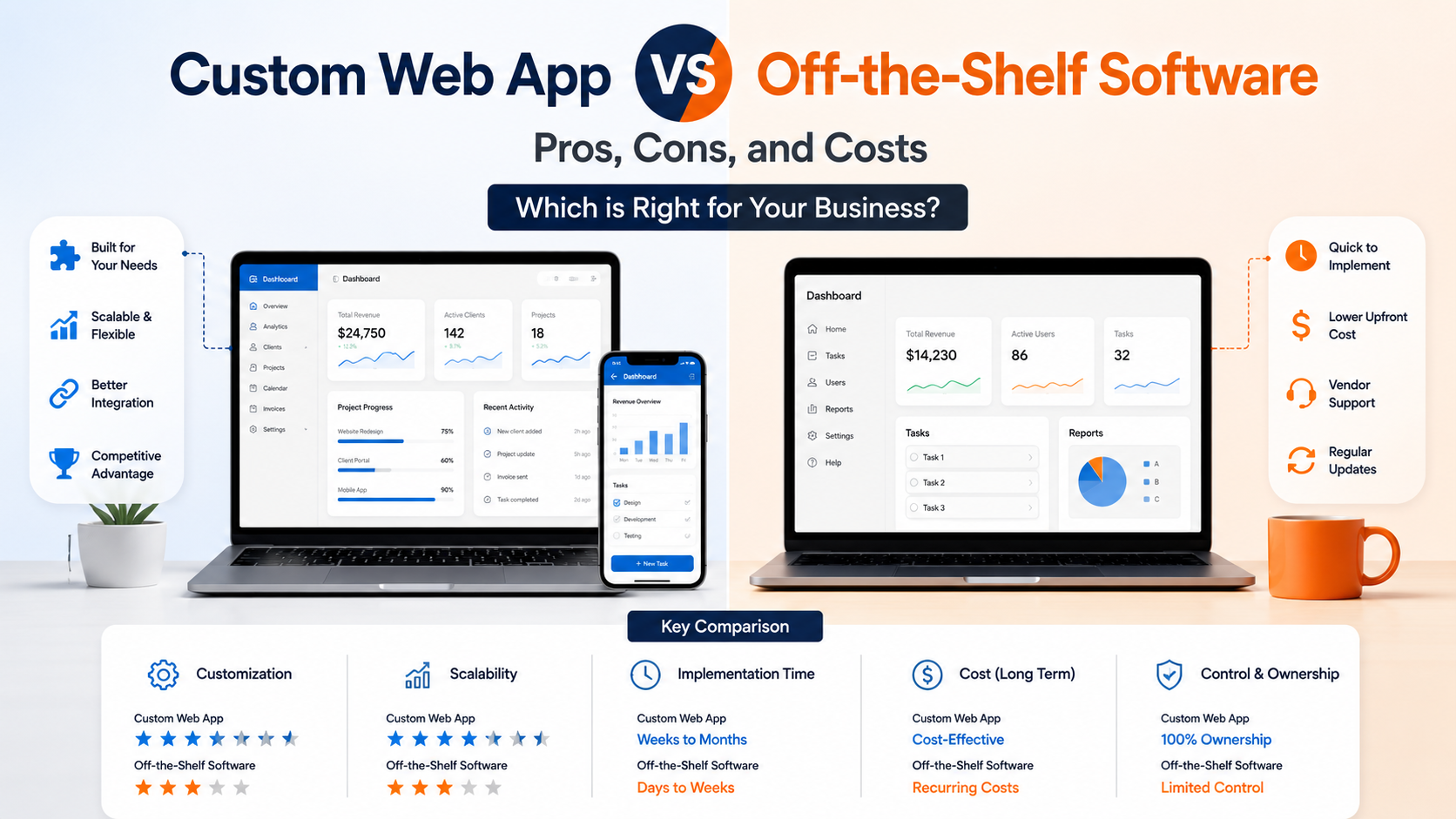
If you’re investing in software for your business, one of the biggest decisions you’ll face is custom web app vs off-the-shelf software. Should you choose an existing platform that’s ready to use today, or invest in software built specifically for your business?
The answer depends on your processes, growth plans, and budget. While off-the-shelf software works well for many businesses, it isn’t always the right long-term fit. Likewise, a custom web application isn’t automatically the better choice. Understanding the trade-offs can help you make a smarter investment.
Understanding Custom Web App vs Off-the-Shelf Software
Before comparing costs, it’s helpful to understand what each option offers.
Off-the-shelf software is a ready-made product designed for a broad audience. It usually includes common business features, monthly subscriptions, and quick setup.
A custom web app is built specifically around your business processes. Instead of adapting your workflow to fit the software, the software is designed to support the way your business already operates.
When evaluating custom web app vs off-the-shelf software, the key question isn’t which option is universally better—it’s which one better supports your current and future needs.
Pros and Cons of Off-the-Shelf Software
Ready-made software is often the fastest way to get started.
Advantages
- Lower upfront costs
- Faster implementation
- Regular software updates
- Large user communities
- Standard business features
For many startups and small businesses, these advantages make off-the-shelf software an excellent starting point.
Limitations
As businesses grow, challenges may appear.
Common limitations include:
- Features you don’t use
- Missing features you actually need
- Monthly subscription costs that continue indefinitely
- Limited customization
- Difficult integrations with existing systems
When workarounds become part of everyday operations, software may begin slowing your team instead of helping it.
When Does a Custom Web App Make Sense?
A custom web app is often worth considering when your business has processes that generic software doesn’t support efficiently.
You may benefit from a custom solution if:
- Employees repeat manual tasks every day.
- Multiple software tools don’t communicate with each other.
- Reporting requires spreadsheets and manual data entry.
- Customer workflows are unique.
- Your business has outgrown standard software.
Rather than forcing your team to adapt, a custom application supports your existing workflow.
SaaS vs Custom App: Which Is More Flexible?
The discussion around saas vs custom app usually comes down to flexibility.
A SaaS (Software as a Service) platform provides standardized features designed to work for thousands of businesses.
A custom application is developed specifically for your organization.
Here’s a comparison:
| Feature | SaaS Platform | Custom Web App |
| Setup Time | Fast | Longer development timeline |
| Customization | Limited | Designed around your workflow |
| Monthly Subscription | Usually required | Depends on hosting and maintenance |
| Integrations | Limited to available APIs | Built for your business needs |
| Scalability | Depends on vendor | Can evolve with your requirements |
The saas vs custom app decision should consider not only today’s needs but also how your business may operate in the future.
Understanding Custom Software Development Cost
One of the biggest concerns for business owners is custom software development cost.
Unlike subscription software, custom development involves an upfront investment. Costs vary depending on factors such as:
- Number of features
- System integrations
- User roles
- Reporting requirements
- Security needs
- Mobile compatibility
For example:
| Solution | Typical Cost Structure |
| Off-the-shelf software | Monthly or annual subscription |
| Custom web application | Initial development plus ongoing maintenance and updates |
When evaluating custom software development cost, consider the long-term operational impact rather than only the initial expense.
If employees spend hours every week working around software limitations, those productivity costs should also be part of the decision.
Build vs Buy Software: A Practical Example
The question of build vs buy software often becomes clearer when viewed through a real-world scenario.
Imagine an ecommerce business selling on Shopify, Amazon, and eBay.
The company uses:
- Inventory software
- CRM
- Accounting software
- Shipping platform
- Multiple spreadsheets
Employees spend approximately two hours every day transferring information between systems because their existing software doesn’t fully integrate.
Buying another SaaS product may solve one issue but create another disconnected workflow.
Building a custom web application could centralize those systems into a single interface designed around the company’s operations.
The right choice depends on whether your existing software supports your business efficiently or requires constant manual workarounds.
How to Decide Between Build vs Buy Software
There isn’t a universal answer to the build vs buy software decision.
Consider these questions:
- Are your current tools meeting most of your needs?
- How much time is spent on manual workarounds?
- Will your business processes become more complex over the next few years?
- Are recurring subscription costs adding up across multiple tools?
- Do you need features that standard software doesn’t provide?
If most answers point toward increasing complexity, custom software may become the more practical long-term investment.
How ZM Collab Helps Businesses Build Practical Solutions
Every business operates differently, which means software should support the way your team works.
ZM Collab develops custom web applications that integrate ecommerce platforms, internal systems, and business workflows into one solution. Rather than replacing technology unnecessarily, the focus is on solving operational challenges with software tailored to your specific requirements.
For businesses already using automation or ecommerce platforms, custom applications can also connect existing systems to improve reporting, workflow efficiency, and scalability.
Final Thoughts
Choosing between custom web app vs off-the-shelf software isn’t simply about cost—it’s about finding the right fit for your business.
Off-the-shelf software often works well for standard processes and quick implementation. Custom web applications become valuable when your business requires specialized workflows, deeper integrations, or greater flexibility than generic software can provide.
If you’re evaluating software for your growing business, visit ZM Collab’s Custom Web Apps page to explore solutions designed around your unique business processes.
Image Alt Text Suggestions
- Custom web app vs off-the-shelf software comparison for small businesses
- Business owner comparing SaaS vs custom app for ecommerce operations
- Custom business dashboard developed through custom web app software
Internal Linking Suggestions
- Custom web application development → Custom Web Apps
- Ecommerce solutions for Shopify, Amazon, eBay, and Etsy → Ecommerce Services
- Business process automation solutions → Automation Services
- Mobile applications for business operations → Mobile App Development
FAQ
What is the difference between a custom web app and off-the-shelf software?
A custom web app is designed specifically for your business processes, while off-the-shelf software is built for a broad range of users. Ready-made software is often quicker to implement, whereas custom applications provide greater flexibility and tailored functionality.
How much does custom software development cost?
Custom software development cost depends on factors such as features, integrations, user roles, reporting requirements, and security needs. Unlike subscription software, custom applications typically involve an upfront development investment followed by ongoing maintenance and updates.
Is SaaS or a custom app better for a small business?
The saas vs custom app decision depends on your business needs. SaaS platforms are ideal for standard workflows and faster deployment, while custom applications are often better suited for businesses with unique processes, complex integrations, or long-term scalability requirements.
How do I decide whether to build or buy software?
The build vs buy software decision should consider your operational requirements, existing workflows, recurring subscription costs, and future growth plans. If standard software requires constant workarounds or multiple disconnected tools, a custom solution may provide greater long-term value.