
If you’re weighing marketplace vs your own store as your first move into ecommerce, you’re facing a decision that shapes almost everything else — your costs, your control over the customer relationship, and how much work it takes to get your first sale. There’s no universal right answer, but there is a right answer for your specific situation.
Here’s how to think it through.
What’s the Real Tradeoff Between Marketplaces and Your Own Store?
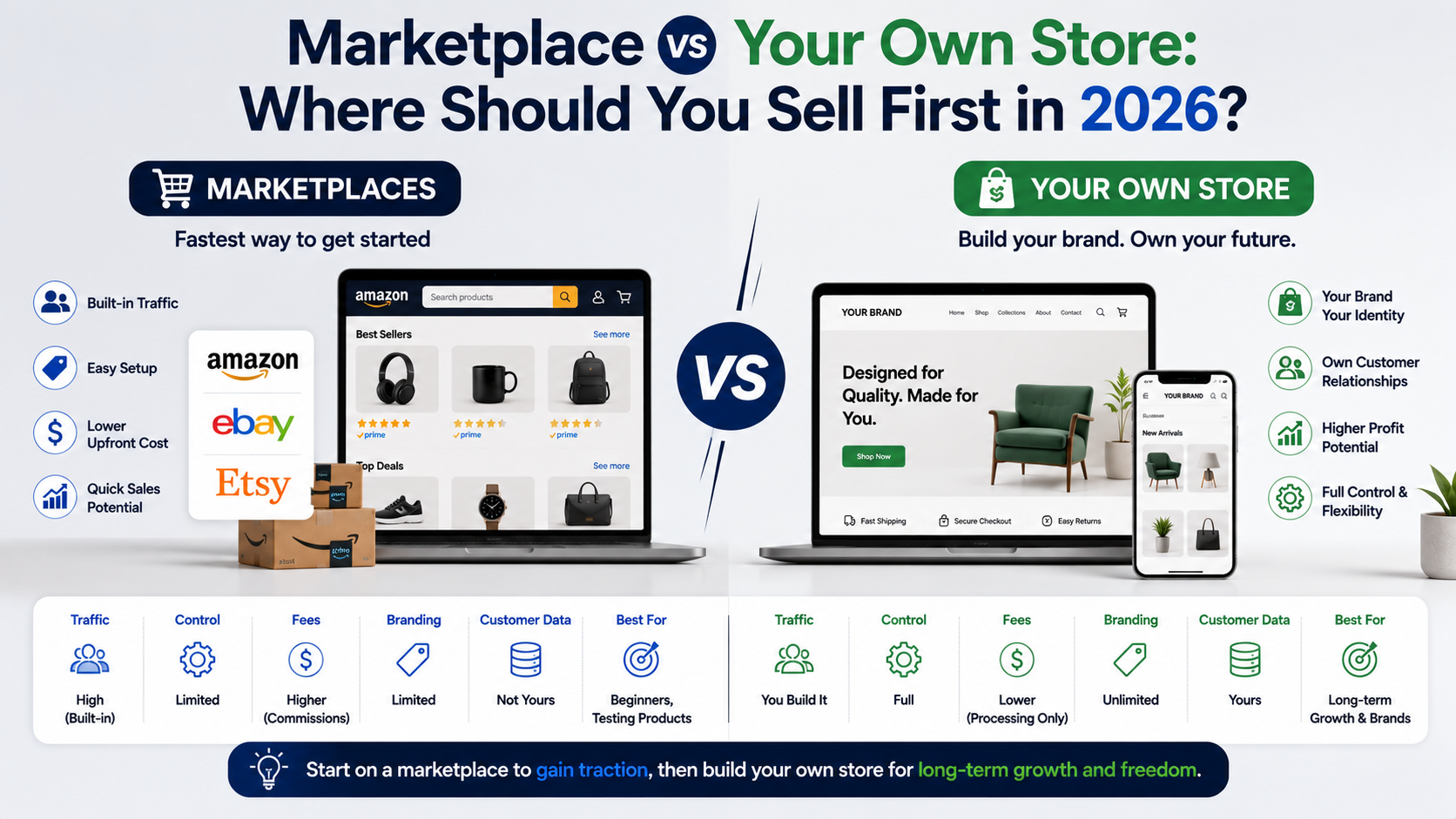
Marketplaces like Amazon, eBay, and Etsy come with built-in traffic. People are already there, searching for products like yours, which means less work getting discovered.
Your own store — typically built on Shopify or a custom platform — gives you full control over branding, customer data, and pricing, but you’re responsible for driving your own traffic from day one.
Neither eliminates effort. They just shift where that effort goes: discovery vs. control.
What Does It Cost to Start Selling on a Marketplace?
Marketplace costs vary by platform, but here’s a general picture:
- Amazon: Referral fees of roughly 8%–15% per sale, plus optional FBA fulfillment costs if you use it
- Etsy: $0.20 per listing, plus a 6.5% transaction fee and payment processing fees
- eBay: Final value fees generally around 10%–13% of the total sale amount
There’s minimal upfront cost to list a product, which is part of why marketplaces are an appealing starting point for many new sellers.
What Does It Cost to Start Your Own Store?
Setting up a Shopify store typically runs:
- Monthly plan: $39–$105 depending on the tier
- Theme: Free to around $350 for a premium option
- Apps: Often an additional $50–$200/month depending on your feature needs
- Marketing/traffic costs: This is the variable that catches new store owners off guard — without built-in marketplace traffic, you’re paying for ads, SEO work, or both to get discovered
A Realistic Example
A candle maker selling on Etsy might get their first sale within days, simply because buyers are actively searching Etsy for handmade candles. That same maker launching a standalone Shopify store with no existing audience or marketing plan might go weeks without a sale, even with a well-designed site, because there’s no built-in discovery mechanism doing the work for them.
This isn’t a flaw in either platform — it’s just a difference in how visibility works.
When Should You Start on a Marketplace?
A marketplace is often the better starting point if you:
- Are new to ecommerce and want to test product-market fit with lower upfront investment
- Don’t yet have an audience, email list, or social following to draw from
- Want faster initial visibility without paying for ads
- Sell in a category where marketplace shoppers already browse heavily (handmade goods, collectibles, everyday products)
When Should You Start With Your Own Store?
Your own store may make more sense if you:
- Already have an audience — social media following, email list, or existing customer base
- Want full control over branding and the customer experience
- Plan to build repeat customer relationships and own that data long-term
- Are willing to invest time or budget in driving your own traffic through ads, SEO, or content
Do You Have to Choose Just One?
No — and for many small businesses, the more realistic path is starting on a marketplace to generate initial sales and validate demand, then building a standalone store once there’s a customer base and some working capital to invest in it. Running both simultaneously is common, though it does mean managing inventory and orders across more than one channel.
What About Selling on Both at the Same Time?
If you decide to run a marketplace presence alongside your own store, the biggest operational challenge becomes keeping inventory and order data in sync across platforms so you don’t oversell or create a disjointed customer experience. This is where ecommerce services built for multi-channel selling can help set up the systems needed to manage both without doubling your manual workload.
So, Where Should You Sell First in 2026?
Ask yourself:
- Do I already have traffic, or do I need to borrow someone else’s? If you’re starting from zero audience, a marketplace usually gets you to your first sale faster.
- How much do I value owning the customer relationship? If long-term branding and repeat customers matter to your business model, your own store becomes more important sooner rather than later.
- What’s my actual budget for driving traffic to a standalone store? Be honest here — a beautiful store with no visitors won’t generate sales on its own.
There’s no wrong starting point, only a starting point that matches your current resources and goals.
If you’re not sure which path fits your specific product and budget, it can help to talk it through with a team that works across both marketplaces and standalone stores. Explore ZM Collab’s ecommerce services page to get a clearer picture of what makes sense for your business.
Image Alt Text Suggestions
- “Comparison chart of marketplace vs your own store for small business owners”
- “Small business owner comparing Etsy and Shopify store setup screens”
- “Multi-channel selling setup combining a marketplace and your own store”
Internal Linking Suggestions
- “ecommerce services built for multi-channel selling” → Ecommerce Services page
- “custom store built specifically for your brand” → Custom Web Apps page
- “syncing inventory and orders automatically” → Automation Services page
FAQ Section
Is it cheaper to sell on a marketplace or start my own store? Marketplaces usually have lower upfront costs since there’s no monthly platform fee, just per-sale fees. Your own store has higher upfront and ongoing costs, especially once you factor in traffic generation, but you avoid marketplace transaction fees.
Can I sell on a marketplace and have my own store at the same time? Yes, and it’s a common approach for small businesses. The main challenge is keeping inventory and orders synced across channels so you don’t oversell or create inconsistent customer experiences between platforms.
Which is better for beginners: Amazon, Etsy, eBay, or Shopify? It depends on your product and audience. Amazon suits everyday products, Etsy fits handmade or vintage goods, eBay works well for auctions or unique items, and Shopify suits sellers with an existing audience wanting full brand control.
How do I know when it’s time to build my own store instead of relying on a marketplace? Consider it once you have consistent marketplace sales, some working capital, and a customer base you’d like to build a direct relationship with. At that point, owning your own store can reduce dependency on marketplace fees and policies.