

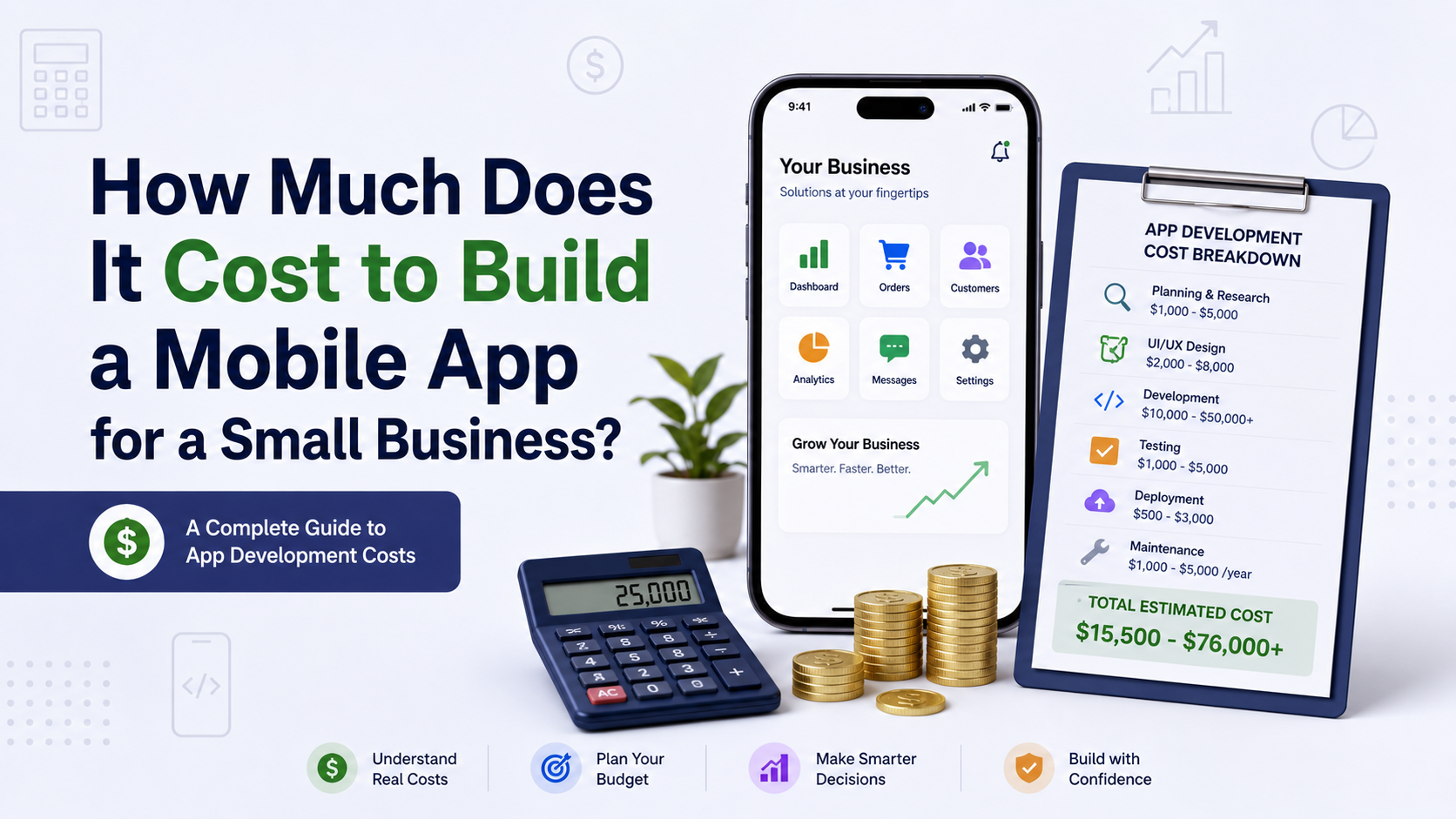
If you’ve been researching mobile app development cost, you’ve probably found estimates ranging from a few thousand dollars to six figures. That wide range can be confusing, especially for small business owners trying to make smart technology investments.
The reality is that there isn’t a single price for building a mobile app. The total cost depends on your business goals, required features, integrations, design complexity, and long-term plans. Understanding these factors will help you create a realistic budget without paying for features you don’t need.
Why Mobile App Development Costs Vary So Much
Every mobile application is different.
A simple customer app that displays information requires far less development than an app with customer accounts, ecommerce features, payment processing, inventory management, and third-party integrations.
The biggest factors affecting mobile app development cost include:
- Number of features
- User account functionality
- Ecommerce capabilities
- Payment integration
- Push notifications
- Custom design
- Backend systems
- API integrations
- Android and iOS support
- Ongoing maintenance
Rather than asking for a single price, it’s more useful to understand what you’re paying for.
Understanding App Development Pricing
One of the biggest misconceptions is that every feature adds only a small amount to the total project.
In reality, app development pricing reflects the time required for planning, design, development, testing, security, deployment, and future updates.
For example, a project may include:
- User authentication
- Product catalog
- Shopping cart
- Order tracking
- Customer notifications
- Admin dashboard
- Payment processing
Each feature requires development, testing, and integration with the rest of the application.
That’s why app development pricing is usually based on project complexity rather than simply counting screens.
Typical Cost Categories
Although every project is different, mobile apps generally fall into three broad categories.
| App Type | Typical Scope |
| Basic App | Informational pages, contact forms, simple customer features |
| Mid-Level App | Customer accounts, notifications, integrations, ecommerce functionality |
| Advanced App | Complex workflows, multiple integrations, custom dashboards, business automation |
The more customized your app becomes, the more development work is typically required.
Rather than selecting the largest possible solution, many businesses begin with essential features and expand over time.
Cost to Build an App 2026: What Should Small Businesses Expect?
If you’re estimating the cost to build an app 2026, focus on business requirements rather than trends.
Questions to consider include:
- Will customers create accounts?
- Do you need online payments?
- Should the app connect with Shopify or another ecommerce platform?
- Will it integrate with inventory or CRM software?
- Do users need push notifications?
- Will administrators manage content through a dashboard?
The more systems your app connects with, the more planning and development are usually involved.
Instead of trying to predict the exact cost to build an app 2026, define the business problem your app will solve first.
Planning a Realistic Small Business App Budget
A successful project starts with a practical small business app budget.
Rather than trying to include every possible feature, prioritize what customers actually need.
For example:
Phase 1
- Customer login
- Product catalog
- Order history
- Contact support
Phase 2
- Push notifications
- Loyalty rewards
- Appointment scheduling
- Personalized recommendations
This phased approach allows businesses to launch sooner while planning future improvements based on customer feedback.
Creating a realistic small business app budget also makes it easier to manage development costs over time.
A Practical Example
Imagine an online retailer currently selling through Shopify.
Customers frequently:
- Check order status
- Contact customer support
- Browse products
- Reorder previous purchases
Instead of directing every customer to multiple webpages, a mobile app could combine these services into one experience.
The retailer decides to launch with:
- Customer accounts
- Product browsing
- Order tracking
- Notifications
Additional features like loyalty rewards and advanced analytics are planned for a future release.
This phased strategy helps control costs while delivering immediate value to customers.
Beyond Development: Ongoing Costs to Consider
When evaluating mobile app development cost, remember that development is only part of the investment.
Businesses should also plan for:
- Hosting
- Security updates
- Operating system compatibility
- Feature enhancements
- Bug fixes
- Performance monitoring
These ongoing costs help keep the application reliable as customer expectations and technology continue to evolve.
Planning ahead makes future maintenance more manageable and reduces the likelihood of unexpected expenses.
How ZM Collab Helps Businesses Build Practical Mobile Apps
Every business has unique goals, workflows, and customer expectations.
ZM Collab develops custom mobile applications tailored to business requirements rather than using generic templates. Whether an app supports ecommerce, customer accounts, internal operations, or integrated business systems, each solution is designed to match how the business actually operates.
For companies that also require automation or custom web applications, mobile apps can be integrated into a broader digital ecosystem that supports long-term growth without unnecessary complexity.
Final Thoughts
Understanding mobile app development cost starts with understanding your business goals.
The right investment isn’t necessarily the lowest price or the most feature-rich solution—it’s the application that solves real customer and operational challenges while fitting your long-term plans.
By defining priorities, planning a realistic small business app budget, and expanding features over time, businesses can make informed decisions without overinvesting upfront.
If you’re exploring a custom mobile application, visit ZM Collab’s Mobile App Development page to discuss a solution designed around your business goals.
Image Alt Text Suggestions
- Mobile app development cost planning for a small business project
- App development pricing comparison for custom business mobile applications
- Small business app budget planning with mobile app development roadmap
Internal Linking Suggestions
- Custom mobile app development services → Mobile App Development
- Custom web applications for business growth → Custom Web Apps
- Ecommerce solutions for Shopify, Amazon, eBay, and Etsy → Ecommerce Services
- Business automation and workflow integration → Automation Services
FAQ
What affects mobile app development cost?
The mobile app development cost depends on factors such as app features, user accounts, integrations, ecommerce functionality, design complexity, security requirements, and support for multiple platforms. Ongoing maintenance and future updates should also be considered when planning the overall investment.
How is app development pricing calculated?
App development pricing is typically based on project complexity rather than a fixed price. Developers consider planning, design, coding, testing, integrations, deployment, and maintenance to estimate the overall scope and timeline of a project.
What is the cost to build an app in 2026?
The cost to build an app 2026 varies depending on the app’s purpose and required functionality. A basic application generally requires less development than one with ecommerce features, customer accounts, business integrations, and advanced workflows. Defining your priorities first helps create a more accurate estimate.
How should I plan a small business app budget?
A practical small business app budget focuses on essential features for the initial release while reserving advanced functionality for future updates. This phased approach helps control costs, gather customer feedback, and expand the app as business needs evolve.